
Building Trusted, Resilient and Intelligent Aviation Infrastructure
At VLM Aviation Infrastructure Advisory, we believe that resilient aviation infrastructure is built through the integration of engineering excellence, cybersecurity, governance, operational assurance and strategic leadership.
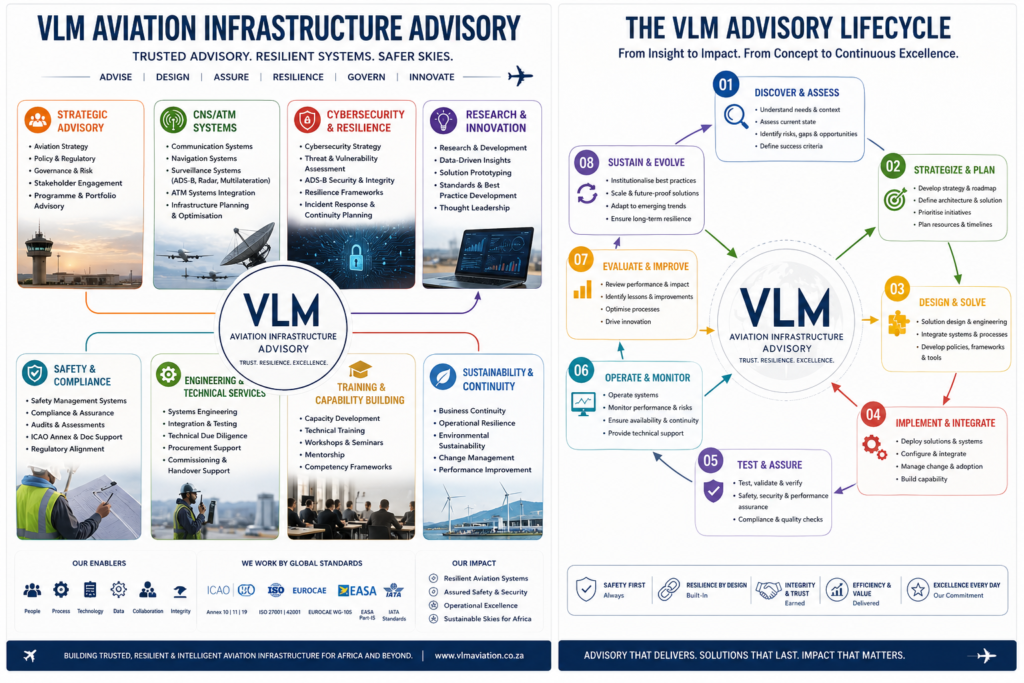
The VLM Advisory Framework brings these disciplines together into a structured methodology for helping aviation organisations assess, modernise, strengthen and sustain mission-critical infrastructure throughout its lifecycle.
Rather than treating engineering, operations, governance and cybersecurity as separate functions, the framework applies a systems-thinking approach to support safer, more resilient and future-ready aviation environments.
Download the complete VLM Advisory Framework for offline reference and sharing.
An Integrated Aviation Advisory Model
Modern aviation infrastructure cannot be managed effectively through isolated technical disciplines. Safety, performance and resilience depend on engineering, cybersecurity, governance, regulatory assurance, operational continuity and organisational capability working together.
The VLM Advisory Framework provides an integrated structure through which aviation organisations can identify risks, establish priorities, design appropriate interventions and strengthen capability over time.
Strategic Advisory
Supporting organisations with strategy development, governance, investment planning, infrastructure transformation and long-term capability development.
CNS/ATM Systems
Providing advisory support across Communication, Navigation and Surveillance systems, air traffic management infrastructure, systems integration and operational optimisation.
Cybersecurity and Resilience
Strengthening the protection, trustworthiness and recoverability of safety-critical aviation systems and operational technology environments.
Engineering and Technical Services
Supporting systems engineering, technical due diligence, infrastructure planning, implementation assurance, commissioning and modernisation.
Safety and Compliance
Aligning technical and operational initiatives with applicable safety, regulatory, governance and assurance requirements.
Research and Innovation
Translating emerging research, technology and industry developments into practical frameworks, tools and decision-support capability.
Training and Capability Development
Strengthening organisational knowledge through advisory support, professional development, knowledge transfer and structured capability-building.
Sustainability and Operational Continuity
Supporting long-term infrastructure performance, continuity, adaptability and resilience in changing operational environments.
The VLM Advisory Lifecycle
From Insight to Impact. From Concept to Continuous Excellence.
The VLM Advisory Lifecycle represents the structured methodology that guides every client engagement. Rather than treating advisory services as a once-off intervention, the lifecycle recognises that aviation infrastructure must continually evolve in response to changing operational demands, emerging technologies, cybersecurity risks, regulatory developments, and organisational priorities.
Each phase builds upon the previous one, creating a continuous cycle of assessment, planning, implementation, assurance, operation, improvement, and long-term resilience. This approach enables organisations to move beyond solving immediate challenges towards developing trusted, sustainable aviation infrastructure capable of supporting future growth.
01. Discover & Assess
Every successful engagement begins with understanding the client’s environment.
This phase establishes a comprehensive understanding of the organisation’s current operating environment, strategic objectives, existing infrastructure, operational challenges, and stakeholder expectations. Through structured assessments and collaborative engagement, VLM identifies opportunities, risks, and the underlying factors influencing organisational performance.
Key activities
- Understand operational context
- Assess current capabilities
- Identify risks and gaps
- Define success criteria
02. Strategise & Plan
Insights gathered during discovery are translated into a clear strategic direction.
Working collaboratively with stakeholders, VLM develops practical roadmaps that align business objectives, regulatory obligations, engineering priorities, and available resources into a coherent implementation strategy.
Key activities
- Strategic planning
- Prioritisation of initiatives
- Resource planning
- Roadmap development
03. Design & Solve
Solutions are designed to address both immediate operational needs and future resilience.
This phase combines systems engineering, operational expertise, governance principles, and innovation to develop practical, scalable and sustainable solutions tailored to the client’s environment.
Key activities
- Solution design
- Systems engineering
- Architecture development
- Policy and framework development
04. Implement & Integrate
Strategies become operational reality.
VLM supports the implementation of agreed solutions while ensuring integration with existing operational environments, governance structures, technology platforms, and organisational processes.
Key activities
- Deployment management
- Systems integration
- Change management
- Capability implementation
05. Test & Assure
Implementation alone does not guarantee success.
Solutions are validated through structured assurance activities to confirm performance, compliance, safety, cybersecurity, and operational readiness before full deployment.
Key activities
- Testing and validation
- Safety assurance
- Compliance verification
- Quality assessment
06. Operate & Monitor
Long-term value depends upon effective operation.
Following implementation, continuous monitoring ensures that systems continue delivering expected performance while identifying emerging risks and opportunities for improvement.
Key activities
- Operational monitoring
- Performance measurement
- Risk monitoring
- Technical support
07. Evaluate & Improve
Continuous improvement is fundamental to resilient infrastructure.
Performance data, operational experience, stakeholder feedback, and emerging industry developments are reviewed to identify opportunities for optimisation and future enhancement.
Key activities
- Performance evaluation
- Lessons learned
- Process optimisation
- Innovation planning
08. Sustain & Evolve
Resilience is achieved through continual adaptation.
The lifecycle concludes by embedding organisational capability, strengthening governance, and preparing infrastructure to respond effectively to future technological, operational, regulatory, and environmental changes. These insights then inform the next cycle of discovery and strategic planning, creating an ongoing partnership focused on continuous improvement.
Key activities
- Strategic advisory
- Future planning
- Organisational resilience
- Long-term partnership
Why a Lifecycle?
The VLM Advisory Lifecycle is intentionally designed as a continuous cycle rather than a linear process. Aviation infrastructure operates in an environment of constant technological advancement, evolving cybersecurity threats, changing regulations, and increasing operational complexity. By continuously revisiting assessment, strategy, implementation, and improvement, organisations can build infrastructure that remains trusted, resilient, and fit for purpose over the long term.